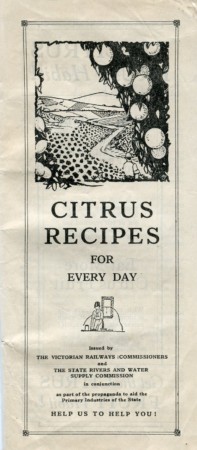
Why in 1928 would Victorian Railways Commissioners publish a large recipe booklet, 72 pages, about how to use oranges?
The answer lies with the appointment in 1920 of Harold Clapp as the railways chairman. He was Australian born of North American parents and spent formative time in the USA working on the electrification of various state and city railways. Clapp led major developments to the intrinsic aspects of the railways, but our interest lies in his interest in developing services for passengers and for primary producers. The Australian Dictionary Biography entry includes this note about dried fruit and oranges: By 1923 a model bakery provided ‘wholesome goods’, especially those containing dried fruit, for sale in refreshment rooms. To encourage the citrus fruit industry he opened a kiosk at Flinders Street station in 1924, set up stalls at other stations, and sold much fruit in times of glut. In November 1926 Clapp began selling pure orange and lemon juice drinks at a stall in Flinders Street station, the first, he claimed, in the Commonwealth.
To take a small detour from this booklet, Michael Symons’ great book One continuous picnic: a gastronomic history of Australia (2nd edition, MUP: Carlton, Vic, 2007) sets out Clapp’s achievements including the development of the ‘novelty product’ raisin bread. Probably in about 1923 he started producing recipe booklets, the first for raisin recipes; 100,000 were distributed. This was followed by recipes for apples, blackcurrants, loganberries and grapes. There is no mention of the recipe booklet shown here.
Citrus recipes for every day drew heavily on a publication of the California Fruitgrowers’ exchange. It included advice about including citrus in every meal and using the fruit to reduce and put increase weight. To focus on just one section – salads; the booklet advises that in the last 10 years, salad ‘has come into its own as the main dish for luncheon’. The section is divided into ‘Whole meal salads’, ‘Ten minute salads’, ‘Salads that children like’, ‘Company salads’, that is when guests join you for a meal.
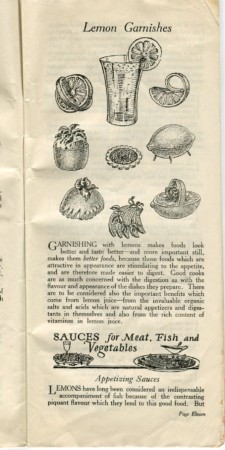
The production is plain with small illustrations built around sections and subheadings. There are a couple of how to do illustrations, like the lemon garnishes illustration from page 11. It concludes with household hints like how to clean piano keys and match striking marks from walls. (The answers involve a plentiful supply of lemons.)
More recipe booklets to come, subscribe to the website to make sure you see them. Look to your right and click on I love ephemera

7 Comments.
A perfect, short piece on an interesting man and intriguing recipe booklets. Plus the “raisin bread” detail!
Thank you
Fascinating reminder of the Railway Refreshment Rooms and their role in the promotion of fruit juice , for example, I remember seeing the Orange Juice dispenser on many occasions at Flinders Street station.
Recipe books such as this one must have encouraged the use of dried fruit in many homes.
We are reminded of the origins of Raisin bread ( and other fruit breads) in Australia
Well done!
Derek, when do you remember seeing the juice dispenser?
Mandy,
I think it would have been the late 1950’s into the early 1960’s and perhaps longer,
Regards,
Derek
Sorting through my Grandmother’s recipes I came across this recipe booklet which seems to be generally the same except mine is dated June, 1932 on the bottom of the inside back cover. How my Grandmother who was born and lived her whole life in Birmingham, UK, would have come into ownership of the booklet I really have no idea! It was very interesting to read your article, as I to was wondering why the Victoria Railways Commissioners would publish such a book. Thank you!
Susan, borrow the book – One continuous picnic if you can – good index and it sheds light on how entrepreurial these transport leaders were – its fascinating