
Agricultural Shows are a mix of continuity and ephemera; lots of traditions and lots of deliberately short-lived experiences and publications.
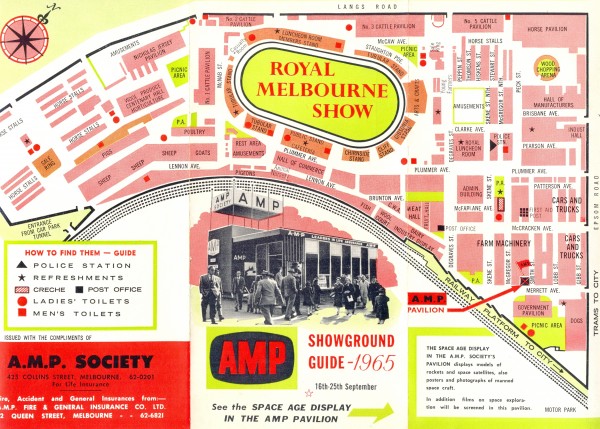
Historian Kate Darian-Smith writes about the Royal Melbourne Show in eMelbourne:
Agricultural societies, based on British models, were established in the Australian colonies to encourage farmers to increase production. In 1842 the Pastoral and Agricultural Society of Australia Felix held Melbourne’s first ‘show’ at the cattle market. From 1848 the Port Phillip Farmers’ Society (PPFS) organised competitive ploughing matches, which soon included livestock and grain demonstrations, commercial stands and amusements. In 1855 the PPFS was granted 3 ha in Sydney Road, Parkville, for a ‘show yard’. The PPFS was replaced by the National Agricultural Society of Victoria (NASV), and the showgrounds relocated to St Kilda Road (1870), and then to Ascot Vale on land adjoining Flemington racecourse (1883). To offset the distance from the city, the government opened a railway line to the Show-grounds and subsidised fares. A Show Day public holiday operated from 1885 until it was revoked in 1994. When the NASV became the RASV in 1890, the name Royal Melbourne Show was adopted.
By the 1920s, the Showgrounds resembled their present form, with purpose-built pavilions erected around a central arena and grandstands. From an initial emphasis on large livestock and machinery, exhibits became more diverse. The first Grand Parade of cattle and horses (1910) has evolved into an increasingly varied spectacle. A Women’s Industries Section, later called Home Crafts, was introduced (1911). Government exhibits educated the public about agricultural and other initiatives. Halls of Commerce (built 1915) and Manufactures (1923) displayed industrial wares. Show bags – distributed free until the 1930s – became part of the Show experience. Catering outlets, including the Country Women’s Association tea-rooms, multiplied….
Records of achievements
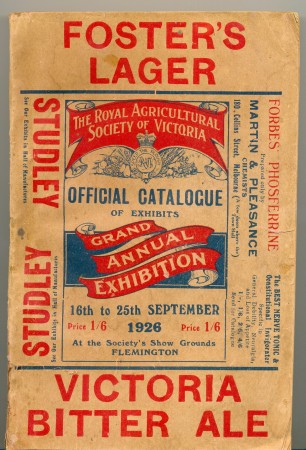
This is a ‘mini telephone size’ book (more than 415 pages) describing all exhibits. It must have been a major effort to publish it in a very short time frame (the period between submission of exhibits and the opening of the Show).
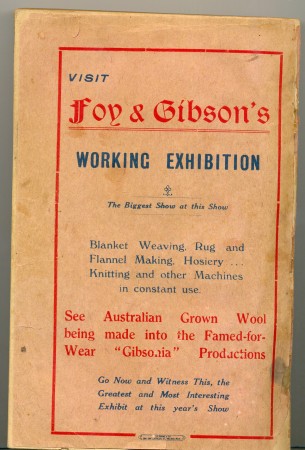
This might explain the rather lacklustre cover. The first few pages are on pink paper and devoted to advertising products such as the Inventor’s Guide to Patents, the Commonwealth Bank of Australia, Cooper Engineering. The catalogue then moves through the various categories and exhibitors. There is advertising of course. Here is an example from the back cover – advertising an exhibition at the Show.
From 1928
Foster’s Lager is a constant advertiser; but this time Show attendees are also offered a Hock Cup, Claret Cup or Champagne Cup at the Hall of Viticulture.
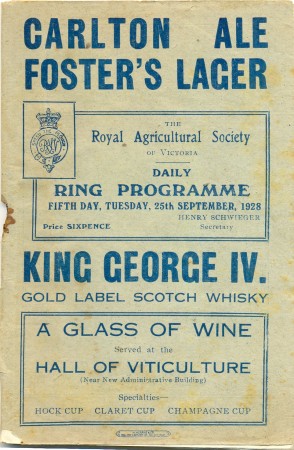
Here is another example of the type of publication produced for the Show; a guide to the programme for the Show ring. This is of course a smaller, stapled pamphlet. It includes maps and notes about events:
- the plan for the sheep dog trials;
- pony jumping;
- diagram and notes about Clydesdale and Light horse, Shorthorn bull, dairy cow;
- lists of competitors.
The events of 25 September include the charming: pair horse trot;handicap wood-chopping; handicap sheaf-tossing; ladies’ driving competition; the ‘Australian’ water jump.
The advertising of course appeals to the country folk attending the Show:
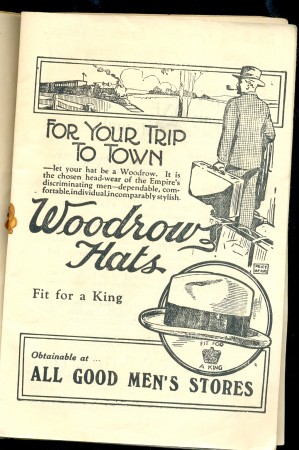
The farmer can wear the same hat as discriminating men in the Empire.
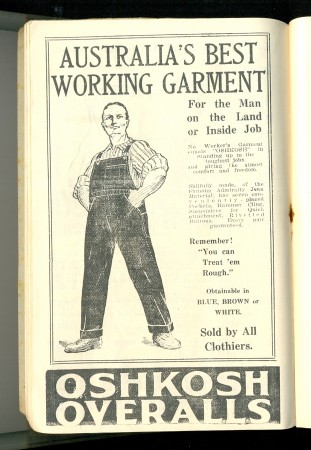
The company website today has a very short note about history:
OshKosh B’gosh was founded in 1895 in Oshkosh, Wisconsin as a manufacturer of hickory-striped denim bib overalls for railroad workers and farmers. (It was the brilliant idea of designing a pint-size version for the children of these customers that gave OshKosh B’gosh its true meaning and purpose.)
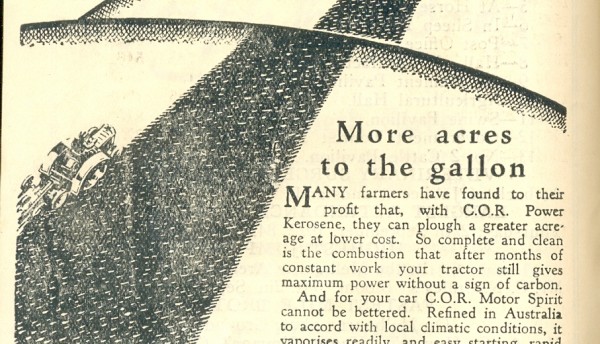
We like this image showing an overhead view of a tractor ploughing over hills – just like a car ploughing along a road.
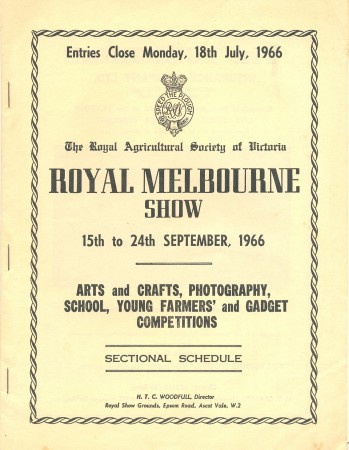
This is another simple, cheap stapled publication. But it predates the Show – it is a schedule for prospective exhibitors. The schedule for arts, crafts and cooking runs to page 15. The Senior Young Farmers’ Competitions include: animals; shearing and wool handling; and farm gadgets. It is not clear what a gadget is – is it an invention? an adaptation of an existing item in the workshop, machinery?
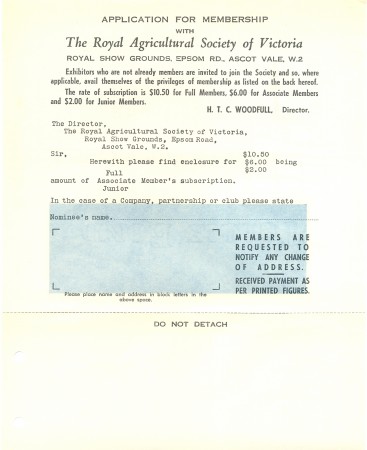
This is a particularly well-maintained item. It has two enclosures: a price list and an application form. While of only modest interest in terms of content, the application form has some interesting features of the time – a carbonised section and a part to detach.
Once again advertising features; here are two nice images:
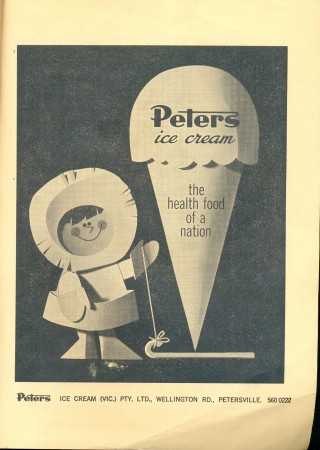
Nice advertising using ‘paper folding’ just as we are seeking currently in TV advertising.
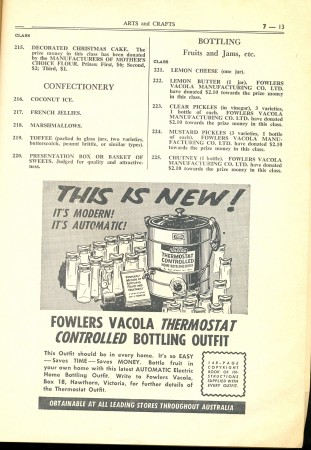
This advertising links directly into the Show’s exhibitors’ activities.
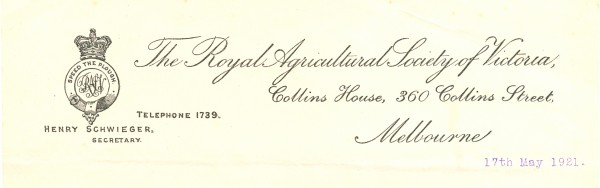
Thanks to ESA member Brian Watson for sharing this material. As Brian loves letterhead, he of course has a Royal Agricultural example:
2 Comments. Leave new
How interesting. The only edition I have is the Catalogue of Exhibits, 26th to 30th September 1916, Which appears to have only been a four day event, maybe because of the First World War.
Possibly as they stopped the Show I think later during the war and instead of competitions they had war effort type activities. There is a published history called Speed the plough I think