
Ephemera for the future
Below is a brief overview of some of the information that was discussed at the ESA’s 2025 Symposium.
I have been collecting ephemera for over 40 years, mostly focussed on Melbourne and Victoria’s history as well as things that look ‘interesting’! With qualifications in museum studies and archives (amongst other things) I have some suggestions for current collectors to consider.
Condition
Try to collect items in the best condition possible. Some dust or a tear can be dealt with but by its very nature, sometimes ephemera will not always be in great condition, found behind furniture, in a long-forgotten drawer or perhaps in a box in a shed, always have an eye to condition. You should avoid items that have active mould or have a mystery powder or other contaminants on them. There is plenty of conservation related advice online to assist you, but do you really want to become a conservator and amateur chemist as part of your collector skills? If you have an item with a mystery contaminant, consider putting it into a sealed plastic storage bag and away from your main collection until you can work out what to do. Seek advice.
Storage
Store your items in a clean, dry and dark storage area, ideally using an acid free or inert storage medium like acid free tissue, paper or card and my preference, polypropylene sleeves. Keep items out of direct sunlight and if you want to display them openly, protect them from dust and other contaminants and have a UV filter on the windows to significantly reduce the possibility of fading of colours. Again, there is lots of advice available online to assist you, but the key is to help the items survive well into the future in the best condition possible for you and others to enjoy. There are specialist local suppliers of archival storage materials who can assist you.
As your collection grows you should consider storage folders, boxes and tubs and a stationery supplier can assist with these. Use a label machine for easy identification of the contents!
Provenance – recording what you know
Sometimes the items we collect don’t have a story – but often they do. Ask the person you are acquiring the item from for their knowledge of the history of the item, where did they get it, how was it created, how was it used, what do they know about it. Sometimes you get an amazing story and sometimes you get a lead on more items that tell a more complete picture, and you can collect those too! Write it down and keep the story with the item! Having the history or provenance of the item often adds a lot to the item itself. Even if there is no story to be told from the seller/donor as such, just recording how you acquired the item is the start of the story! We all love a story about the ‘find’, the mystery box in the back of a shed that was about to be thrown out, the skip bin finds whilst walking the dog, the friend who says ‘this is probably junk, but I thought you might like these old papers…’
Finding a new home
Sometimes our collecting interests change, other times we need to downsize or perhaps the collection is now part of a deceased estate. They key thing is to have a plan on what you want to happen to your collection. If you have built a collection over 10 or 20 or 50 years or more, do you want to risk it going into a skip bin by those who do not understand or care about the value or significance of the collection? You will likely know other collectors who might be interested in your items, or perhaps it may be better in a formal collection – your local historical society, or perhaps the PMI Victorian History Library, the State Library or some other specialist organisation. Don’t leave it to chance and don’t leave it to the last minute. Perhaps a few items should be ‘preserved for the future’ in a collection but the rest of your collection could be sold other given to others who collect. Maybe there is a club or organisation that specialises in the type or theme of material you collect, and they can help you find a new home for it, maybe to assist a new collector get started? Again, the key thing is to have a plan. Please don’t leave this to the last minute. Does your executor know what you want done with the material?
Many community groups and specialist organisations have limited resources and very limited storage space, so the process of considering your donation may take months or longer. For those with significant and possibly valuable collections there are schemes like the Commonwealth Cultural Gifts Program that could provide a tax deduction for the value of your donation.
Members of the ESA would be happy to assist you with any questions you might have about how to care for and potentially re-house your collection.
Comments from the editor
I asked Michael if he could assist by starting the ball rolling on ideas about collecting. And I asked him to keep it to a certain length. But now I would like to add in my current issue about collecting. This arises in my current volunteer work. I have been identifying ephemera and photographs about some ephemeral and undocumented subjects. You must date the item as best you can, and record the basis for the date or guestimate.
Dating
Michael emphasises recording as much information as you can about the item. My background is in libraries. One of the most important pieces of information is the likely date of publication. The least you can record is when you acquired the information. This will mean that at least you can date the item as “no later than 2025”.
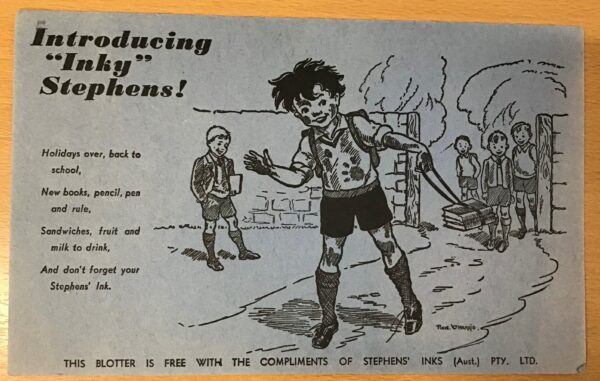
There is usually more detective work that you can do. Our example is this blotter from the collection of our secretary Lyndel W. The obvious ways to get a date are:
- Search for a catalogue entry for the blotter.
- When did Stephens’ Inks (Australia) Pty Ltd operate?
- The artist whose signature is at the bottom of the illustration is Pixie O’Harris. When did she work? And when in her career might she have worked on an item like this?
- When did children stop using ink pens at school? When did blotters go out of use?
- A harder question, given my skill set – what era do the boys’ clothing come from?
Stephens’ Inks 1930-1955
The English company Stephens’ Inks set up business in Sydney in the 1930s. (I found this in a Google search.) Stephens Inks registered as a company in Australia in September 1930. It went into voluntary liquidation in 1955. (I found this information in a Trove newspapers search.) We have a date range 1930-1955.
Pixie O’Harris 1921-1991
O’Harris’ working life began in Sydney with a one-year stint with John Sands Ltd. She was employed as a commercial artist in the early 1920s. O’Harris was prolific: she wrote and/or illustrated nine books in the 1930s; 21 in the 1940s and five in the 1950s. (I skimmed her very interesting and informal autobiography. There were lots of references to different work projects but none to this blotter.)
This doesn’t advance the dating. There seem to be at least two options. Firstly, that O’Harris drew it when she was short of work. Or rather did Stephens Inks have the funds to commission a very popular artist in the 1940s.
I wondered if Pixie’s signature on the blotter might assist. NO – she signed her work in a great variety of ways. And she often didn’t sign at all.
When did children stop using ink pens in school?
My experience is that I smeared my way through middle school with a fountain pen, that was in the mid-1960s. Again, this question doesn’t assist in refining the dating of the blotter.
What era do the boys’ clothing come from?
I have searched via Google Lens. It makes my guestimate [early 1940s]. Is there someone who really knows out there? Or someone who has a better method for searching clothing styles.
I look forward to correspondence about this.
Mandy B
This article was first published in the Ephemera Newsletter #21 January 2026